Technology Roadmap
Sixth edition
October 2026

The Technology Roadmap (TRM) guides ERA’s technology strategy, business planning, program design, and investment decisions.
What it does
- Identifies where ERA’s mandate and model can have the greatest impact
- Aligns ERA with government priorities, technology trends, and Canada’s innovation system
- Builds a balanced portfolio that accounts for uncertainty in the pace of change
How it’s built
- Internal research and lessons from 17+ years of ERA investments
- Ongoing consultation with the Governments of Alberta and Canada
- Sessions with academic, industry, and ecosystem leaders
- Repeated refinement and validation
Four objectives
Promote Alberta’s vision
Establish Alberta as a leading jurisdiction for developing and deploying technologies that improve environmental performance, attract talent and investment, keep businesses globally competitive, and build recognition as a hub for competitive emissions-reduction innovation.
Characterize the state of play
Understand Alberta’s needs and strengths, the technologies it needs for a carbon-neutral future, the barriers to adopting them, and keep ERA’s strategy responsive to fast-changing trends.
Define the optimal investment focus
Align with ERA’s mandate and market needs, target underfunded areas where funding has the most leverage, and make sure Albertans share the health, affordability, and resilience benefits.
Set guideposts and metrics
Track, benchmark and report outcomes so there is a clear line of sight between ERA funding and meaningful economic and environmental impact.
Seven guiding principles
Alberta’s emissions outlook
Canada’s 2026 National Inventory Report, with data through 2024, highlights significant differences in emissions across provinces and sectors, underscoring the need for regionally tailored solutions.
Alberta’s emissions by sector MtCO2e

Oil and Gas Production, Refining, and Distribution – 154

Transportation – 23

Buildings – 20

Agriculture and Forestry – 23

Electricity – 17

Heavy Industry, Mining, and Manufacturing – 17

Waste, Light Industry, & Other – 8
Pathways to 2050
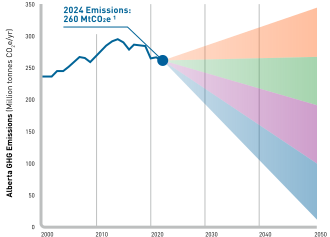
Emissions have stabilized near 260 Mt, 12% below the 2014 high but still 3.5% above 2005, the base year for Canada’s binding targets. The May 2026 Alberta-Canada MOU reaffirms a shared net-zero ambition alongside economic growth.
| Year | Emissions (Mt CO2e) |
|---|---|
| 2000 | 236.57 |
| 2001 | 236.26 |
| 2002 | 237.53 |
| 2003 | 245.93 |
| 2004 | 245.76 |
| 2005 | 251.15 |
| 2006 | 259.51 |
| 2007 | 267.75 |
| 2008 | 266.2 |
| 2009 | 259.49 |
| 2010 | 268.49 |
| 2011 | 277.48 |
| 2012 | 286.68 |
| 2013 | 292.2 |
| 2014 | 295.5 |
| 2015 | 290.75 |
| 2016 | 279.27 |
| 2017 | 287.32 |
| 2018 | 286.47 |
| 2019 | 285 |
| 2020 | 265 |
| 2021 | 267 |
| 2022 | 262 |
| 2023 | 260 |
| 2024 | 260 |
| Pathway | 2050 low (Mt CO2e) | 2050 high (Mt CO2e) |
|---|---|---|
| The technology imperative | 260 | 330 |
| The baseline | 190.9 | 260 |
| The impact | 118.9 | 190.9 |
| The vision | 50 | 118.9 |
1 Most recent available historical data from Canada’s 2026 National Inventory Report
The technology imperative
New developments above the baseline could grow emissions in the absence of improved technologies
The baseline
Illustrative range of potential Business-as-Usual scenarios based on current policies and practices
The impact
Technologies funded by ERA to date, if commercialized, have the potential to significantly reduce annual emissions compared to the baseline by 2050
The vision
Future ERA investments, guided by the Technology Roadmap, could further bend the curve down
The commercialization journey
Six ways ERA supports projects

Capital innovation grants
Non-dilutive funding to share risk on pilot, demonstration, and first-of-a-kind projects.

Pre-FID study funding
Feasibility support for large, capital-intensive projects with lower technology risk.

Deployment incentives
Direct incentives to accelerate mass deployment and adoption of commercially ready technologies.

Commercialization supports
Talent, advice, and services that help SMEs advance their technologies.

Capacity building
Energy management training that improves energy performance and competitiveness.

Strategic analysis
Studies and modelling of technology pathways and market potential.
Five technology focus areas
To achieve the TRM’s objectives, ERA takes a portfolio approach using five cross-sectoral technology focus areas.
Area
Definition
Share of go-forward investment

Energy systems
Looking to the future of energy: Reshaping how clean electricity and fuels are produced, stored, and delivered while strengthening the grid and critical energy infrastructure.
20%–35%

Industrial frontiers
Expanding the opportunity space: Transforming the environmental and economic performance of Alberta’s major sectors via step-changes in the processes, practices, and feedstocks they use, while also supporting development of new low-emissions products and industries.
20%–35%

Enhanced efficiency
Optimizing performance and productivity: Driving towards best-in-class management of energy and resources across the economy via improvements in productivity, optimization, and conservation.
15%–25%

Circular economy
Closing the loop: Reimagining how resources, materials, products, and waste streams are managed throughout their lifecycle to reduce raw material demand, reduce or upcycle waste, and sustain and recover value while enhancing conservation, treatment, remediation, and reclamation of land, soil, air, and water.
15%–25%

Carbon management
Cleaning up: Natural and artificial technologies and practices to capture or remove carbon, convert or utilize it in new products, and/or permanently sequester it.
10%–20%
Measuring performance

Portfolio mix
Share of investment by focus area and technology class.

Project outcomes
Actual and forecast GHG reductions, economic and environmental benefits.

Commercialization
Success rates, project attrition and progression.

Knowledge
Technology transfer, Intellectual Property, and export potential.

No single technology, sector or pathway can meet Alberta’s emissions and competitiveness challenges alone. ERA’s diversified portfolio supports technologies across sectors, maturity levels, and time horizons.